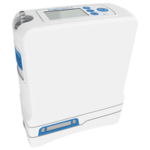
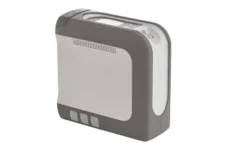
+ Lightest portable concentrator at only 2.9 lbs + Smallest portable concentrator at 5.8 inches wide x 2.7 inches deep x 7.5 inches high + Can connect to your smartphone + Pulse settings from 1-4 + Battery life up to 5 hours 45 minutes
The Inogen Rove 4 sets a new standard in portable oxygen concentrators, delivering the highest oxygen output in the lightest 4-setting device on the market. At just 2.9 lbs with the standard battery and capable of producing up to 840 mL/min of medical-grade oxygen, it’s designed for active users who want power without bulk.
The Rove 4 uses Inogen’s Intelligent Delivery Technology® to detect your breath and deliver oxygen precisely when you need it—within the first 250 milliseconds of inhalation. This ensures maximum oxygen absorption and efficiency, even during sleep or physical activity. It also adjusts automatically to your breathing rate, providing optimal therapy whether you’re resting or on the move.
Designed with user comfort in mind, it features a bright digital display, intuitive control buttons, and a redesigned speaker for clearer audio signals. With a rugged build and an 8-year expected service life (when used less than 8 hours/day), the Rove 4 offers long-lasting reliability. The carry case and optional backpack or hip bag provide flexible ways to take it with you, wherever life takes you.
Starter package includes: Rove 4 device, battery, AC & DC power cords, carrying case, and manual.
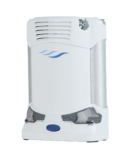
+ Curved design to fit comfortably against patient’s hip + Includes exclusive Comfort Zone program with superior support, uptime guarantee, and get acquainted call + UltraSense technology to ensure oxygen is delivered to you when you need it + Pulse settings from 1-5 + Battery life up to 16 hours
The CAIRE Freestyle Comfort is CAIRE’s latest innovation in wearable, portable oxygen concentrators, engineered for maximum comfort and efficiency. Weighing only 5 pounds with a slim, ergonomic design, it fits naturally against your body for comfortable wear wherever you go. With simple one-touch operation, a color user interface, long-lasting battery options, and UltraSense breath detection, the Freestyle Comfort ensures that oxygen is delivered exactly when you need it.
Choose between the compact 8-cell battery at 5 pounds or the extended 16-cell battery, adding just 1 pound more. Designed to fit snugly against your body’s natural contours, this concentrator includes a stylish carrying bag with a non-slip padded shoulder strap, making it a hands-free, ultra-portable solution.
The Freestyle Comfort delivers powerful, customizable oxygen flow with pulse dose settings from 1 to 5, and a maximum output of 1050 mL per minute. Powered by CAIRE’s UltraSense technology, it automatically adjusts to your breathing rate—whether you’re resting, active, or sleeping—to deliver oxygen right at the start of each breath, maximizing efficiency when your body needs it most.
Enjoy up to 4 hours of continuous use on a setting of two with the 8-cell battery, or extend up to 8 hours with the 16-cell option. Both batteries recharge quickly—3.5 hours for the small battery and up to 6 hours for the large. The Freestyle Comfort charges while in use whenever it’s connected to AC or DC power, ensuring uninterrupted support on the go.
Operating at a whisper-quiet 39 decibels, this concentrator is perfect for home, restaurants, or church. FAA-certified, it’s ready for air travel with most major airlines, giving you true freedom to take it anywhere. Backed by an industry-leading 3-year warranty on the unit and sieve beds—an exclusive benefit that can save you hundreds—and a 1-year warranty on the battery and power supplies, the Freestyle Comfort is built for long-term reliability and peace of mind.
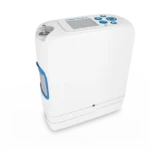
+ Very quiet at only 37 decibels + Intelligent oxygen delivery + Large user-friendly LCD screen + Pulse settings from 1-6 + Battery life up to 12 hours 45 minutes
The Inogen Rove 6 is a compact, yet powerful portable oxygen concentrator (POC) designed for ultimate convenience and portability. Weighing less than 5 pounds and comparable in size to a handbag, this POC delivers high concentrations of medical-grade oxygen at up to 1,260 ml per minute, making it ideal for staying active—whether you’re out with friends, traveling, or running errands.
Engineered for flexibility, the Rove 6 includes a long-lasting standard battery, giving you reliable oxygen therapy on the go. For extended freedom, you can opt for an additional battery, which significantly increases battery life. With a sleek design measuring 7.18 x 3.27 x 8.14 inches, the Rove 6 fits seamlessly into your lifestyle. The standard battery lasts up to 6 hours, while the extended battery can power the unit for up to 12 hours, ensuring you have oxygen support throughout your day. Both rechargeable Lithium-ion batteries recharge in 4 to 8 hours, keeping downtime minimal.
Operating at just 37 decibels, the Rove 6 is one of the quietest portable concentrators on the market. Its low noise level is quieter than a normal indoor conversation, allowing you to use it comfortably in social settings without disruption. The Rove 6 is compatible with Inogen Connect, a free mobile app that enables you to monitor your POC’s status directly from any Apple or Android device. With Inogen Connect, you’re always in control of your oxygen therapy, anytime, anywhere.
The Inogen Rove 6 combines power, portability, and discretion, delivering a reliable and comfortable oxygen therapy experience wherever you go.
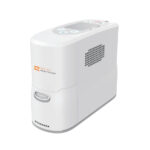
+ Offers 3 different battery sizes + 2-year warranty on sieve beds + Works up to 10,000 feet + Pulse settings from 1-3 + Battery life up to 7 hours 12 minutes
The Rhythm P2-S3 portable oxygen concentrator (POC) is an ideal solution for those needing dependable, 24/7 oxygen therapy without giving up mobility. Proudly manufactured in Florida by Rhythm Healthcare, this ultra-lightweight unit weighs just 3.3 pounds and provides three pulse-dose flow settings, making it one of the lightest, most travel-friendly POCs on the market.
Whether you’re exploring the world or enjoying a stroll through your neighborhood, the Rhythm P2-S3 is designed to go wherever you do. At just 3.3 pounds, it easily fits into its convenient carry bag with a comfortable shoulder strap. The compact dimensions (3.4” x 6.2” x 6.7”) make it a breeze to carry, and it’s FAA-approved for airline travel, so you’ll have oxygen support wherever you go.
The P2-S3 is user-friendly with an intuitive LCD screen displaying battery life, alerts, fault indicators, and breath detection. Easily access the on/off button, flow controls, and mute/audio settings, making operation straightforward and stress-free.
Enjoy peace of mind with the P2-S3’s multiple power sources. Choose from three battery options: the single battery offers up to 2 hours 30 minutes, the medium battery up to 4 hours 48 minutes, and the large battery up to 7 hours 12 minutes. You can recharge the device with an AC power source for wall outlets, or in vehicles, RVs, and boats with the DC power cable. For additional convenience, the P2-S3 external battery charger allows you to keep extra batteries ready.
The Rhythm P2-S3 Starter Package includes everything you need to get started: a brand-new unit, rechargeable Lithium-Ion battery, AC and DC power adapters, a custom carrying case, filter, cannula, and manual—providing you with freedom and reliability in one complete package.
+ Excellent durability with protective rubberized casing + Most sensitive conserver trigger on the portable concentrator market + Large LCD screen + Pulse settings from 1-5 + Battery life up to 5 hours
The Drive iGO2 Portable Oxygen Concentrator is a compact, durable oxygen therapy solution, built for users who want reliable oxygen on the go. Featuring SmartDose Auto-Adjusting Conserver Technology and an ultra-sensitive conserver trigger, the iGO2 adapts seamlessly to your oxygen needs while providing rugged durability with its protective rubberized casing—ideal for long-term use.
Weighing only 5 pounds with the battery, carry case, and strap, the iGO2 is designed for true portability. You’ll have the freedom to enjoy activities outside your home, with oxygen therapy that’s easy to carry wherever you go—even in a car, boat, or RV. The battery is quick to load, and the carry case includes space for two spare batteries for added convenience. An illuminated battery indicator lets you keep track of power at a glance.
With a large LCD screen and an intuitive control panel, the iGO2 is easy to use, even when placed on the ground under a car or airplane seat. Choose from pulse-dose settings 1 to 5, giving you control over your oxygen delivery. The ultra-sensitive conserver trigger—among the most responsive on the market—ensures fast and efficient oxygen delivery precisely when you need it.
Safety is built-in, with audible alerts for low oxygen output, low battery, high temperature, device malfunctions, and no breath detected (PulseDose mode). These alerts ensure you’re aware of any issues, promoting a safer user experience and helping maintain the device’s longevity by prompting timely repairs. With a rugged rubberized casing to protect against impacts and a long nipple adapter to prevent tubing kinks, the iGO2 is designed for years of reliable use.
The iGO2 Starter Package includes everything you need for immediate use: a brand new iGO2 portable concentrator, two batteries, an AC power adapter, DC power cable, custom carrying case, cannula, and manual—equipping you with a complete, reliable oxygen therapy solution for life on the go.
Understanding Portable Oxygen Concentrators
What Are Portable Oxygen Concentrators?
Portable oxygen concentrators are compact, battery-powered devices that deliver supplemental oxygen to individuals who need higher oxygen levels than what is available in the surrounding air. Unlike traditional oxygen tanks, these devices extract oxygen from the ambient air, eliminating the need for refills and making maintenance simple and convenient.
How Do Portable Oxygen Concentrators Work?
Portable oxygen concentrators (POCs) operate similarly to home oxygen concentrators but are designed for mobility. They are lightweight, easy to carry, and some models are even approved for airline travel. Here’s a step-by-step look at how these devices function:
Air is drawn in from the surrounding environment.
The air is compressed within the device.
Nitrogen is filtered out, leaving concentrated oxygen.
The oxygen is delivered to the user via a nasal cannula or mask.
Oxygen concentrators are categorized into two main types: stationary and portable.
Portable Oxygen Concentrators: These devices are designed for mobility and convenience, making them ideal for use outside the home. They are lightweight and typically run on rechargeable lithium-ion batteries, although they have a lower oxygen output compared to stationary models.
Stationary Oxygen Concentrators: Designed for home use, these units deliver continuous oxygen flow at higher volumes. They are larger, often weighing between 30 to 55 pounds, and are equipped with wheels for easier mobility within the home.
The choice between these options depends on your lifestyle and oxygen needs. While stationary concentrators offer higher oxygen output at a lower cost, portable devices are travel-friendly and better suited for active lifestyles. Consult your healthcare provider to determine the best fit for your requirements.
Types of Oxygen Concentrators
The ideal portable oxygen concentrator depends on your health condition, lifestyle, and budget. Your healthcare provider can guide you in selecting the right device based on your oxygen needs and activity level.
How to use a Portable Oxygen Concentrator
Using a portable oxygen concentrator is straightforward:
Connect the nasal cannula or mask to the device.
Turn on the concentrator and set the prescribed oxygen flow rate.
Monitor the battery life on the display and carry an extra battery if you’ll be away from a power source for an extended period.
For cleaning, use mild dish soap and water, being careful to avoid water contact with the tubing. Replace the nasal cannula tubing every two to four weeks or sooner if damaged.
Who Benefits from Portable Concentrators?
Individuals with conditions that lead to low blood oxygen levels (hypoxia), such as COPD, asthma, lung cancer, heart failure, or congenital heart disease, may benefit from using portable oxygen concentrators.
Key Features to Consider in a Portable Oxygen Concentrator
When selecting a portable oxygen concentrator, consider the following factors:
Oxygen Delivery Modes: Portable concentrators can deliver oxygen in pulse mode or continuous flow. Pulse mode is ideal for individuals with sufficient breathing ability to trigger oxygen delivery, while continuous flow is necessary for those with tracheostomies or very low breathing capacity.
Battery Life: Pulse mode devices generally have longer battery life than continuous flow models. For air travel, ensure you have sufficient battery power, as airlines require enough charge for 150% of the flight duration.
Size and Weight: Portable oxygen concentrators range from 2.8 to 20 pounds. Smaller models are more portable but offer lower oxygen capacity. Choose a device that aligns with your oxygen needs and lifestyle.
Health Benefits of Portable Oxygen Concentrators
These devices provide the freedom to maintain an active lifestyle while meeting oxygen needs. Many models offer up to 24 hours of oxygen delivery, enabling travel and outdoor activities without worry. Most are lightweight and FAA-approved for air travel.
Safety and Potential Risks
While oxygen is non-flammable, it supports combustion. Follow these safety precautions:
Avoid smoking or open flames near the device.
Ensure proper ventilation around the concentrator.
Regularly check for alarms or device issues.
Using higher oxygen flow rates can lead to nasal dryness or nosebleeds, but humidifier attachments can alleviate these symptoms. Avoid over-the-counter oxygen concentrators, as they may not meet medical needs for serious conditions like COPD.
Lifespan of a Portable Oxygen Concentrator
With proper care, a portable oxygen concentrator can last four to seven years. Batteries may require replacement sooner. Regular cleaning and maintenance are essential for maximizing the device’s lifespan.
+ Over 20+ trusted models from industry-leading manufacturers + Industry Leading Accreditation: ACHC Accredited and an A+ Better Business Bureau Rating + Breathe Easy Guarantee: 100% Seven Day Return Policy and 100% Price Match Guarantee + Lifetime Technical Support: Service and support for the life of your unit